The history of our church building
Knowle Parish Church first opened in 1403. The church is generally known by this name now, or sometimes shortened to 'KPC', but the official Church of England name is Knowle: St John the Baptist & St Laurence & St Anne.
The hamlet of 'Cnolle' was within the manor and parish of Hampton-in-Arden. The church at Hampton was a three-mile walk away, not too easy for the parishioners in Knowle to reach when the un-bridged River Blythe was in flood. Knowle got its own church through the initiative and funding of a wealthy benefactor – but remained a daughter church of Hampton for over 400 years until 1858 when it finally became a parish in its own right.
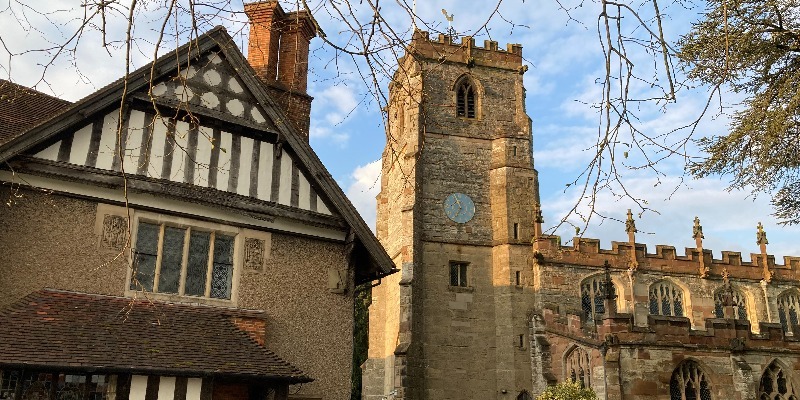
The greatest benefactor to Knowle was ‘local man made good’ Walter Cook. This wealthy man, with key connections especially in London and Rome, obtained permission in 1396 from Pope Boniface IX to build a chapel in honour of three Saints, John the Baptist, Laurence the Martyr and Anne. The chapel was built on land belonging to Walter’s parents.
Construction commenced on a building that is smaller in area and height than today’s church. There was a smaller bell-cote instead of today’s splendid tower, no south aisle and a shorter chancel. Consecration of the church was on the 24th February 1403 by a Scottish bishop.
Saved by the river
The church was saved from the destruction common to many at the time of the Reformation because the villagers of Knowle pleaded that crossing the River Blythe to the parish church at Hampton was often impossible and that they needed their church in Knowle. Today we are grateful that the church survived as the place where we still worship today.
Growth
Many developments continued as the village grew. Vestries, an organ loft, the south aisle and a chancel extension extended the area, while the tower and a clerestory increased the height.
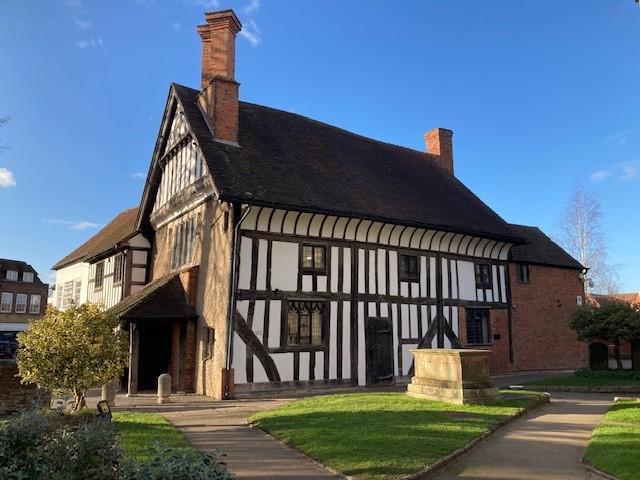
The adjacent timbered Guild House (dating from 1412, pictured below) was given to the Church in 1912 by the local landowner Mr. Jackson of Springfield Hall.
In 1980 the new verger’s house was built and received a civic award. This was later converted to a parish office and called St. Lawrence house (note the spelling change over the years). St. John’s Hall was built and dedicated in 1995 and has been a major contribution to the life of the Church.
The Bells
The first recorded bells were hung in Knowle in 1687. The three bells were transported up the River Avon to Stratford or Warwick and then by road to Knowle. In 1897, the year of Queen Victoria’s Diamond Jubilee, the original bells were recast as part of a new ring of 6 bells. Two smaller bells (trebles) were added in 1931 to create a ring of 8 bells, three of which were recast in 1979.
More information
You can buy a short book about the church, key points of interest and its architecture from the church for £1. These are available on Sundays and when the church is open (most mornings 9.30am-1.30pm).
A popular history of the village and Church, ‘The History of Knowle’ by Eva Wootton was published in 1972 and later reprinted. The most complete history and description may be found in the privately published (1966) book by Anthony A. Upton – ‘The Collegiate Church of St. John Baptist, Laurence and Anne of Knowle, Warwickshire’. Both books may be found in the local collections of the Knowle and Solihull libraries.